
How To Use Ai To Make Money Online
Creating a sustainable income online is a goal many professionals strive toward, and AI is making it more attainable than ever. Last year alone, AI-driven businesses netted an increase in profits by up to 40%. This staggering number shows that leveraging AI tools can significantly impact your earning potential.
AI can revolutionize the way we make money online, whether it's through automated trading, content creation, or personalized marketing. Historically, getting a business off the ground required extensive resources and time. However, with AI, you can streamline operations and reduce overhead, thus increasing profitability. This isn't just theory; companies deploying AI have seen remarkable outcomes in efficiency and revenue.
- Identify tasks suitable for AI automation, such as customer service or data analysis.
- Implement AI-driven tools for content generation and personalized marketing.
- Analyze market trends with AI to make informed business decisions.
- Utilize AI in trading algorithms for quicker, efficient trades.
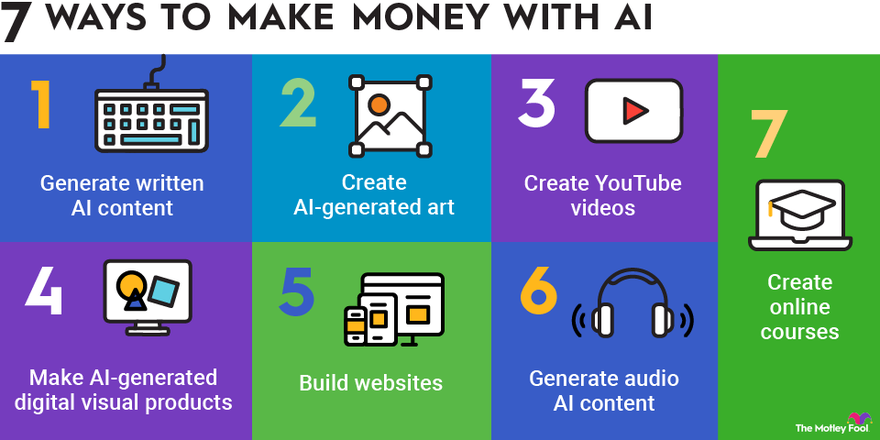
Source: foolcdn.com
How to Use AI to Make Money Online
One way to use AI to make money online is by automating tedious tasks. For example, AI chatbots can handle customer service inquiries, saving time and resources. Many businesses also use AI to analyze data and predict trends, which helps in making informed decisions. Automating tasks means you can focus on more strategic parts of your business. This boosts efficiency and ultimately, profitability.
Another popular method is through AI-driven content creation. Programs can generate articles, social media posts, and even video scripts. According to this post, using AI-generated content can help maintain a steady flow of information to engage your audience consistently. Furthermore, AI can optimize content for search engines, improving your website’s visibility. This leads to higher traffic and potential revenue.
AI can also be leveraged in e-commerce through personalized recommendations. By analyzing user behavior, AI tools suggest products that a customer is more likely to buy. This tailored shopping experience increases customer satisfaction and sales. For more information about optimizing your online presence, you can read here is the article. Personalized marketing strategies are crucial for standing out in competitive markets.
Finally, consider AI in the realm of financial trading. AI algorithms can evaluate market data much faster than humans can. This allows for quick and efficient trades that capitalize on small market fluctuations. This method requires an initial setup but yields significant returns. Many traders have switched to AI-powered strategies to stay ahead of the curve.
Understanding AI
AI, or Artificial Intelligence, is a technology that enables machines to mimic human intelligence. This can range from simple tasks like sorting emails to complex functions like driving a car. The core of AI is its ability to learn and adapt from data inputs. Unlike traditional software, AI improves over time without additional programming. This makes it highly versatile and powerful.
AI can be split into two main types: Narrow AI and General AI. Narrow AI is designed to perform a specific task, like voice recognition or online recommendations. According to this post, narrow AI is what most businesses use today to make money online. General AI, on the other hand, aims to perform any intellectual task a human can. This type is still in development and is more complex.
AI systems usually involve machine learning, where the program learns from large amounts of data. These datasets are crucial for AI to make accurate predictions and decisions. For example, online retailers use AI to analyze past purchases and predict future buying habits. This helps them offer personalized recommendations to customers. When done correctly, this boosts sales and customer satisfaction.
Furthermore, understanding AI requires knowing its ethical implications. AI can be used for good or bad, depending on its design and application. Some people worry about job displacement, while others see AI as a tool for innovation. Open discussions about AI are essential for developing regulations and ensuring its ethical use. AI’s potential is vast but must be managed responsibly.
Identifying Opportunities for AI
First, look at repetitive tasks in your business that could benefit from automation. AI can free up time by handling customer service, data entry, and email sorting. For example, AI chatbots can resolve customer queries quickly. Automating such tasks enhances efficiency and cuts costs. This allows you to focus on strategic planning.
Next, consider areas where predictive analytics could improve your decision-making process. AI tools can analyze past data to forecast future trends. Companies in various sectors use AI to plan inventory, manage risk, and develop marketing strategies. The healthcare industry also uses AI to predict patient outcomes. These applications save both time and resources.
Additionally, think about customer experience enhancements. AI can offer personalized recommendations and dynamic pricing models. For instance, online retailers use AI algorithms to suggest products based on browsing history. This personalized approach increases sales and customer loyalty. When done right, it can significantly boost your profit margins.
Finally, don't forget content creation and management. AI can help generate engaging articles, social media posts, and videos. It can also optimize your content for search engines, improving visibility. Content creators benefit significantly from these AI applications. Enhanced content can lead to higher engagement and more revenue.
Implementing AI in Your Business
To start implementing AI, identify the key areas where it can have the most impact. For many businesses, this includes customer service, data analysis, and marketing. AI can handle these tasks more efficiently than human employees. Begin by researching AI tools suitable for your specific needs. This research phase is crucial for effective integration.
Next, integrate AI into your customer service department. Chatbots can respond to customer inquiries 24/7, providing immediate support. They can answer common questions, resolve basic issues, and even assist with online orders. This reduces wait times and improves customer satisfaction. Over time, this can lead to increased customer loyalty and higher sales.
Another effective area for AI is data analysis. AI algorithms can examine large datasets to reveal patterns and trends. You can use this information to make informed business decisions. AI can predict customer behavior, market trends, and even potential risks. Businesses that utilize data-driven strategies often see significant growth.
In marketing, AI can help personalize your campaigns. AI tools can analyze customer data to create targeted advertisements. These personalized ads are more likely to attract attention and convert into sales. Additionally, AI can optimize your content for search engines. This ensures your marketing efforts reach a larger audience.
Finally, consider using AI for inventory management. AI can predict which products will be in demand, helping you manage stock levels efficiently. This minimizes the risks of overstocking or running out of popular items. AI-driven inventory systems can save both time and money. They allow you to focus on scaling your business.
The Benefits of Using AI
One of the biggest advantages of using AI is increased efficiency. AI systems can process large amounts of data much faster than humans. This speeds up decision-making and operations. Tasks like data entry, scheduling, and customer service can be automated. As a result, businesses can focus on more strategic activities.
AI also improves accuracy in various tasks. For example, AI algorithms can analyze financial data to detect anomalies that might indicate fraud. In healthcare, AI can assist in diagnosing illnesses with high precision. This reduces the margin for error and increases trust in automated systems. Reliable data analysis can lead to better outcomes and decision-making.
Another key benefit is cost reduction. By automating repetitive tasks, businesses can save on labor costs. AI-driven processes require less human intervention, cutting down on operational expenses. This means higher profitability in the long run. Companies can then reinvest these savings into other areas of growth.
AI enhances customer experience through personalized interactions. AI tools can provide product recommendations based on customer preferences. This tailored approach makes customers feel valued and understood. Personalized experiences can lead to higher customer satisfaction and loyalty. Happy customers are more likely to return and make repeat purchases.
Finally, AI provides businesses with valuable insights. By analyzing trends and patterns, AI can guide strategic planning. For instance, AI can predict market trends, helping companies stay ahead of the competition. Companies that embrace AI technologies often find themselves better positioned in the market. They can adapt swiftly to changes and capitalize on new opportunities.
Future Possibilities for AI in Online Business
The future of AI in online business looks promising with many possibilities on the horizon. One potential is the further personalization of customer experiences. AI could make online shopping even more tailored to individual preferences. Imagine logging in and seeing products curated just for you. This level of customization could greatly enhance user satisfaction.
Another possibility is the advancement of AI-driven marketing strategies. AI could analyze consumer data to create even more precise ad campaigns. These campaigns would target customers at the right time and with the right message. Enhanced targeting could lead to higher conversion rates. Businesses will likely see better returns on their marketing investments.
As AI technology evolves, we might see more sophisticated chatbots and virtual assistants. These AI agents could handle more complex queries and provide in-depth support. This would free up human employees to focus on creative and strategic tasks. Superior customer service could become a standard in online businesses.
AI could also revolutionize inventory management and logistics. Imagine a system that predicts demand so accurately that overstock and stockouts become a thing of the past. Efficient supply chain management would reduce costs and improve delivery times. Customers would receive their orders faster, enhancing their overall experience.
Looking further ahead, AI might even play a role in product development. Companies could use AI to identify trends and create products that meet future demands. AI could analyze customer feedback to improve existing products. This proactive approach could give businesses a competitive edge in the market.
Frequently Asked Questions
In this section, we address common questions related to using AI for making money online. Read on to find answers that can help enhance your understanding and implementation of AI.
1. What are common applications of AI in online business?
AI can be used in various ways to benefit online businesses. Common applications include customer service automation, data analysis, and personalized marketing campaigns. These tools help streamline operations and improve efficiency, saving time and resources.
Moreover, AI can optimize supply chains by predicting stock needs based on consumer behavior. This leads to better inventory management and reduced costs. Implementing these applications helps businesses stay competitive in a fast-paced market.
2. How does AI improve customer experience?
AI enhances customer experience by offering personalized interactions and recommendations. For instance, chatbots provide immediate responses to queries, reducing wait times and improving satisfaction levels. Personalized product suggestions increase the likelihood of purchases.
Additionally, AI can analyze browsing histories to recommend similar products or services that a customer might like. This results in a tailored shopping experience that makes customers feel valued and understood. These measures contribute significantly to higher retention rates.
3. Can small businesses benefit from AI?
Yes, small businesses can greatly benefit from integrating AI into their operations. By automating routine tasks like scheduling or inventory management, they save valuable time and resources that could be allocated elsewhere.
Furthermore, affordable AI tools are now available even for smaller budgets, making technology accessible to everyone. With proper implementation, small businesses can achieve greater efficiency and compete with larger enterprises effectively.
4. Is it expensive to implement AI solutions?
The cost of implementing AI solutions varies depending on the complexity and scope of the project. While some initial investment is required for setup and training, long-term benefits like increased efficiency often outweigh these costs.
Moreover, there are numerous scalable AI solutions available today that cater to different budgets. Small-to-medium-sized enterprises can start with basic functions before expanding as they grow more comfortable with the technology.
5.Is there a risk of job loss due to increasing use of AI?
The fear of job loss is one concern surrounding the rise of artificial intelligence.There will likely be a shift rather than an outright elimination; new roles might emerge requiring individuals skilled at managing these systems.Furthermore,many jobs involving critical thinking & creative tasks can't easily replaced by machines ensuring continued need for human workforce in many sectors.
< p > However,this transition also emphasizes importance re - skilling employees equipping them better utilize coexist alongside advancing tech thereby mitigating adverse impacts associated rampant automation while capitalizing benefits offered thereof.Data conversion specialists or robot team managers such novel fields examples where manual labor transitioned intelligently .
Final Thoughts
Leveraging AI to make money online presents numerous opportunities for growth and efficiency. Whether through automating customer service or optimizing marketing campaigns, AI offers valuable solutions for modern businesses. Implementing these technologies can lead to significant cost savings and improved customer satisfaction.
As AI continues to evolve, its applications will only become more versatile and powerful. Staying informed about the latest advancements ensures your business remains competitive. Embracing AI isn't just about keeping up; it's about staying ahead in an ever-changing digital landscape.

Viola R. Daigle
I'm Viola R. Daigle, a dedicated Internet Marketer. I work with WarriorPlus as a Vendor and Affiliate, and I’m also an Affiliate on JVZoo and Legendary Marketer. My passion is to provide honest and detailed reviews of Internet Marketing (IM) products and software. I love helping people choose the right tools and strategies to grow their online business with confidence.


